Compressed air is one of the most expensive utilities in your plant, and almost everything that goes wrong with it is invisible. Wet air looks the same as dry air. Oil at the limit of a purity class cannot be seen in any sight glass. A leak is masked by production noise, and a compressor running unloaded looks just as busy as one doing useful work.
Measurement turns each of those unknowns into a number you can act on. Here is what each instrument tells you.
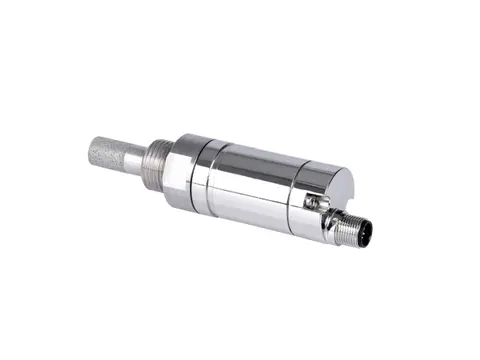
Dew point meter: is the air really dry?
Air at +20 °C PDP and air at −40 °C PDP look identical in a pipe, yet the first carries about 180 times more water vapour. Small changes matter: a desiccant dryer that drifts from −40 °C to −20 °C PDP sends eight times more water downstream.
Without measurement, the first evidence of a dryer failure is liquid in drip legs, rust in filter bowls, frozen instrument lines or a rejected batch, each appearing well after the fault began. A dew point meter shows you the change as it happens.
Pressure sensor: where is the pressure going?
When a machine reports low pressure, the usual response is to raise the compressor setpoint. If the real cause is a 1.5 bar drop across loaded filters, a restrictive hose or an undersized branch pipe, that raises energy use for the whole plant and still leaves the machine short at peak demand. Each extra bar of discharge pressure raises compressor energy by about 7 %.
Pressure sensors placed along the air path locate the restriction, so you can remove it instead of paying for it.
Flow meter: how much air do you really use?
Compressing 1 m³ of free air to 7 bar g requires at least 0.079 kWh under ideal adiabatic single-stage conditions. A plant using 1,000 m³/h for 6,000 hours a year needs at least 475,000 kWh of compression energy.
Without measured flow, that cost cannot be divided between users, tracked against production or checked against leaks. Nameplate ratings overstate demand, because machines rarely run at full consumption at the same time. A flow meter shows the true peak, the base load and the storage you need.
Leak detector: what is escaping?
The US Department of Energy’s compressed air sourcebook states that leaks in a typical plant waste 20–30 % of compressor output, and that a well-maintained system should keep leakage below 10 %.
A real 1 mm hole at 7 bar g passes roughly 45–67 l/min. A 60 l/min leak draws about 0.4 kW continuously, around 3,400 kWh a year in a system that stays pressurised, and a 3 mm hole wastes nine times as much. Leaks keep running when production stops, and in a plant at 80–90 dB(A) you cannot hear them. A leak detector picks up the ultrasound they make, so you can find, cost and fix every one.
Air quality measurement: is the air clean enough?
Air at Class 1 for oil contains at most 0.01 mg/m³. The difference between Class 1 and Class 3 oil is a factor of 100, with no visible sign. A coalescing filter that is saturated, bypassed or fitted with a damaged seal can let contamination through while its gauge still reads normal, and clean air can pick up rust, scale and condensate on its way through old pipework.
A result measured at the plant room says nothing about the air at a filling machine 200 m away. Compressed air quality measurement at the point of use does.
Power meter: what does your air cost?
A 110 kW compressor averaging 90 kW for 8,000 hours a year uses 720,000 kWh. Nameplate ratings do not show what it actually draws, and panel ammeters mislead, because they show current rather than power.
Oil-injected screw compressors commonly draw around 25–35 % of full-load power while unloaded, delivering no air at all. In a plant with fluctuating demand, a large share of the energy can go to unloaded running, and only a logged power meter trace reveals its size.
Measured values are what auditors accept
ISO 50001 requires energy performance to be tracked from measured data, and ISO 11011:2013 bases compressed air assessments on measured demand. Food, medical, breathing and pharmaceutical air all have to be demonstrated by test. A specification that is not measured cannot be demonstrated to an auditor, a customer or a regulator.
Measure it yourself, or let us
We supply every instrument above. If you would rather have the answer than the instrument, our engineers carry out dew point measurement testing, compressed air flow testing and compressed air quality testing on site, and report every result from logged, measured data.