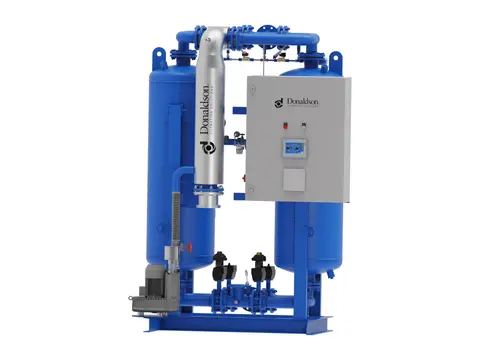
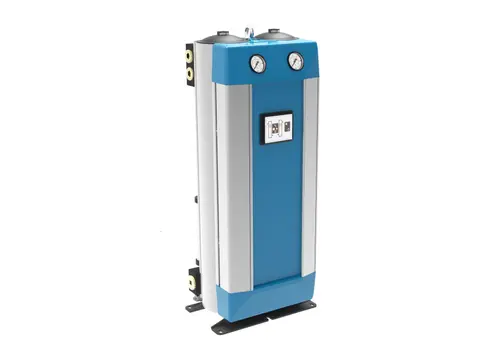
A heatless desiccant dryer has two towers of desiccant. At any moment one dries your air while the other is regenerated by a share of that dried air, the purge, expanded to atmosphere. There is no heater, so the dryer relies entirely on the purge reaching the bed at the right pressure and in the right amount.
Small faults upset that balance quickly. Just 0.5 bar of back pressure from a clogged silencer raises the purge requirement at 7 bar g from 14.5 % to 21.7 %, leaving the bed under-regenerated. Here is what to look after, and how often.
Check the tower pressure gauges every shift
The drying tower should read line pressure and the regenerating tower near zero.
- A regenerating tower that stays pressurised points to a blocked exhaust or a failed valve.
- A drying tower below line pressure points to a leak.
Check the drains every day
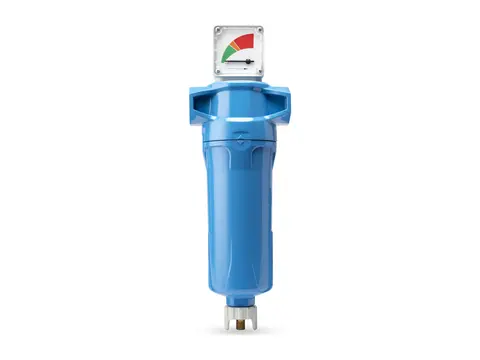
Check filter and separator drains daily and service them every 6–12 months. A failed drain floods the filter housing, liquid carries over into the dryer, and a single slug can take the outlet dew point off specification.
Set the purge for the pressure you actually run
The purge fraction depends on the pressure ratio, so verify the setting whenever your system pressure changes. A setting made for 7 bar g under-purges at 5 bar g and wastes air at 10 bar g.
Every 6 months: the exhaust silencers
Inspect the silencers every 6 months and replace them annually or when blocked. Desiccant dust clogs them and creates back pressure in the regenerating tower, and that back pressure is what drives the purge requirement up.
Every 12 months: filters and sensors
- Replace the coalescing pre-filter elements every 12 months, or sooner if differential pressure reaches the manufacturer’s limit. Any oil that passes a saturated element coats the desiccant pores, and ambient-temperature purge cannot remove it, so pre-filter neglect permanently shortens desiccant life.
- Replace the particulate after-filter elements every 12 months, or at the differential pressure limit. A blocked element raises pressure drop, and each extra bar your compressor has to generate costs about 7 % more energy. A ruptured one releases abrasive alumina dust into valves and instruments downstream.
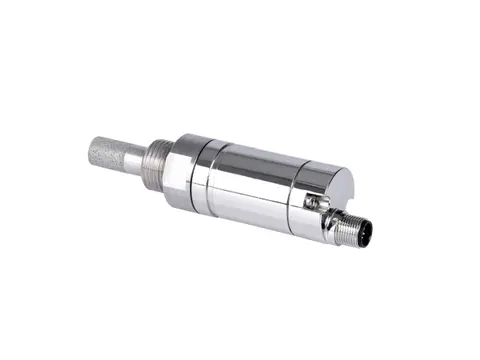
- Calibrate the dew point sensors against a traceable reference. An uncalibrated sensor can show a compliant reading while wet air reaches your process.
Every few years: valve seals and desiccant
- Replace valve seals every 2–4 years. A leaking inlet seal lets wet air bypass into the regenerating tower. A leaking exhaust seal vents compressed air continuously and stops the tower repressurising before changeover.
- Replace the desiccant every 3–5 years, or when the outlet dew point rises under unchanged operating conditions. Beads lose surface area over time, so replace both towers together to keep them regenerating evenly.
Keep a monthly log
Write down dew point, differential pressure and tower pressures once a month. Gradual trends reveal desiccant ageing, filter loading and valve wear before any of them causes a quality failure.
Let our engineers take a look
Our dryer health testing shows whether your dryer meets its rated pressure dew point, and how much compressed air and energy it consumes to do so. Our commissioning and service team looks after the dryer and its filters, drains, bypass valves and dew point measurement point.